


Focal adhesion
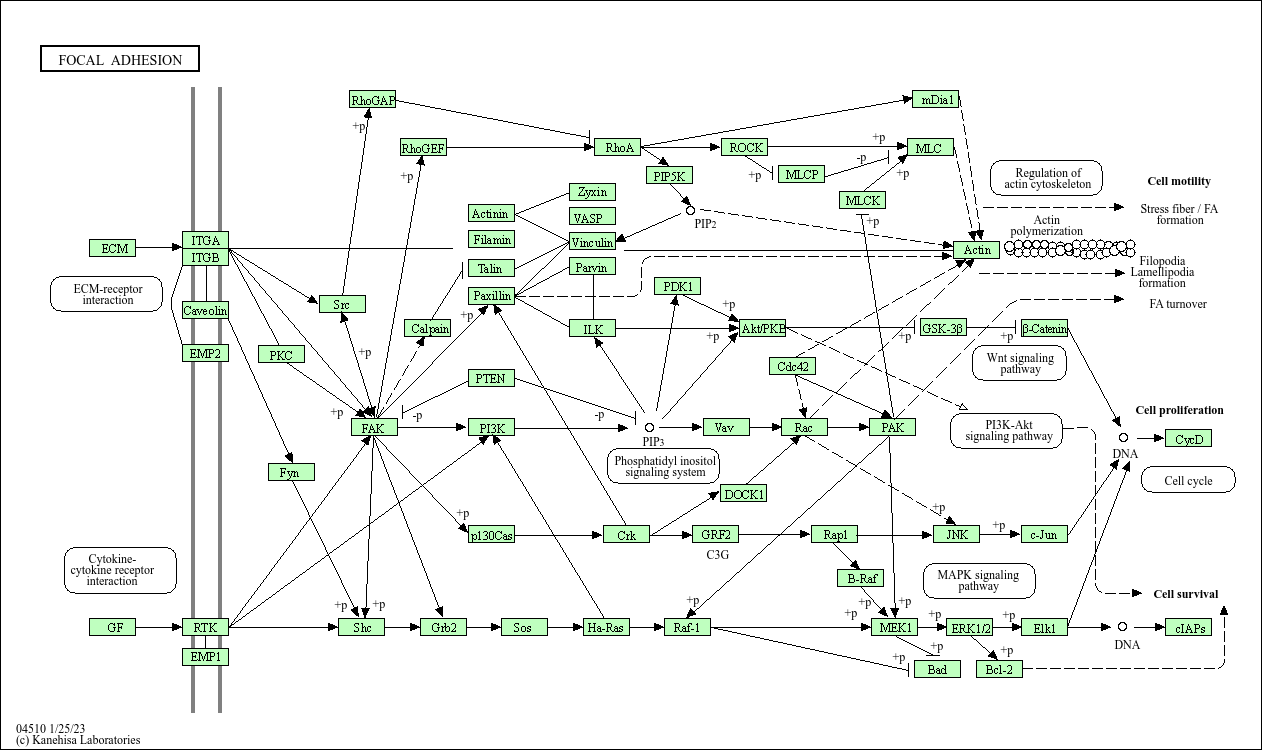
Core of basic research: Deciphers the molecular mechanism of dynamic adhesion between cells and the extracellular matrix (ECM), participating in cell migration, proliferation, mechanical sensing, and signal transduction. The core complex is mediated by Integrins: Integrin heterodimers (e.g., α5β1, αvβ3) bind ECM components (Fibronectin, Collagen) via extracellular domains, while intracellular domains recruit signaling molecules such as FAK and Paxillin to form focal adhesion structures, linking to the actin cytoskeleton. Activated FAK initiates pathways like PI3K-Akt and MAPK to regulate cell survival and migration; it also transmits mechanical signals to sense ECM stiffness and adjust cell behavior. Research focuses include Integrin activation mechanisms, the dynamic assembly and disassembly of focal adhesions, mechanical signal transduction pathways, and the association of pathway abnormalities with tumor metastasis (e.g., overactivated FAK promoting cell migration) and fibrotic diseases.
Core key proteins: Integrin family (α5β1, αvβ3, α2β1, etc.), Focal Adhesion Kinase (FAK), Paxillin, Vinculin, Talin, Actin, Myosin, Src kinase (regulating FAK phosphorylation), PI3K/Akt (survival signaling pathway), MAPK (ERK, migration regulatory pathway), ECM components (Fibronectin, Collagen).
Core key proteins: Integrin family (α5β1, αvβ3, α2β1, etc.), Focal Adhesion Kinase (FAK), Paxillin, Vinculin, Talin, Actin, Myosin, Src kinase (regulating FAK phosphorylation), PI3K/Akt (survival signaling pathway), MAPK (ERK, migration regulatory pathway), ECM components (Fibronectin, Collagen).
Product list
-
{{item.title}}{{item.react}}{{item.applicat}}
Product list
Product name
Reactivity
Application
Related Resource Links


Related Promotional Journal Downloads


Explore Our Recommended Popular Products
More products

30,000+ high- quality products available online
Primary Antibodies, Secondary Antibodies, mIHC Kits, ELISA Kits, Proteins, Molecular Biology Products,Cell Lines,Reagents ...
Contact Us
-

400-801-6722
-

support@lamarck.cn
-


Order
-

Message