


TGF-beta signaling pathway
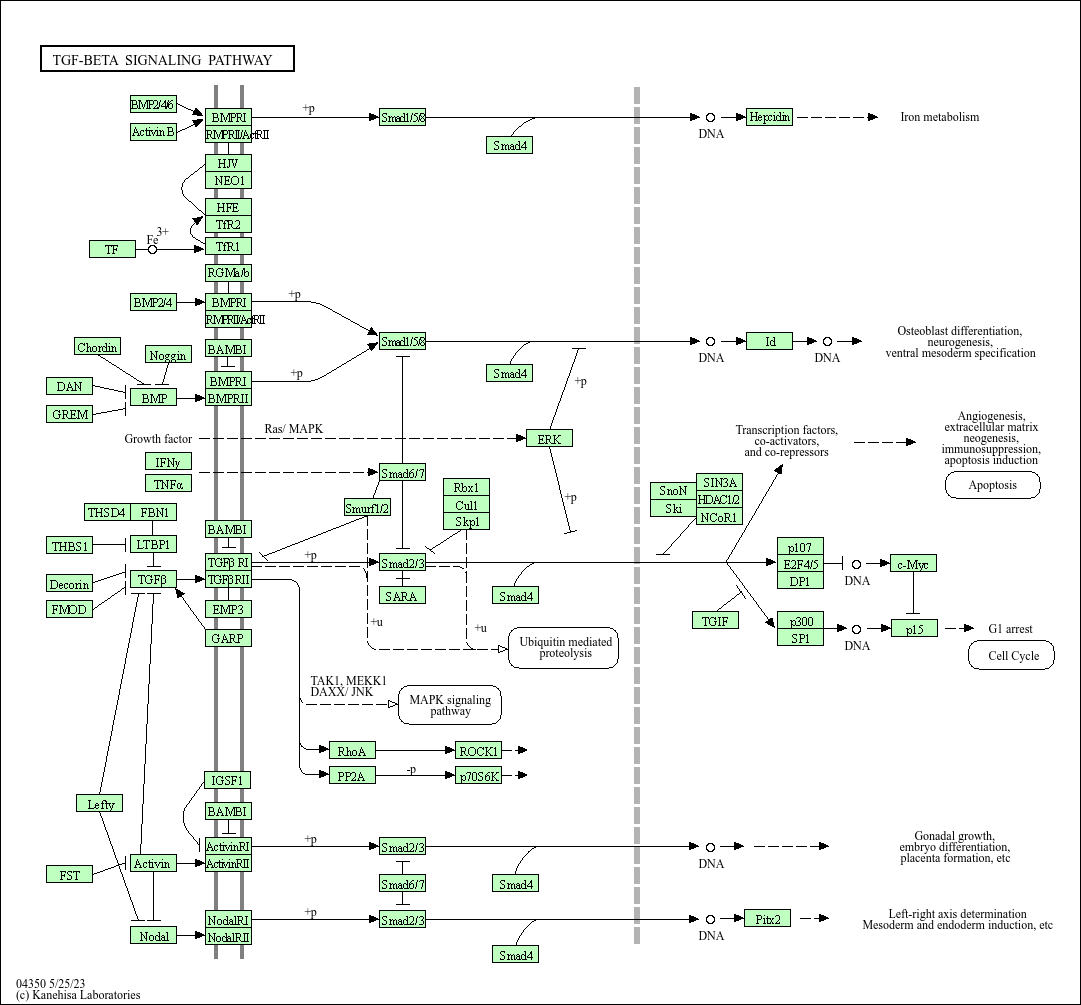
Centered on core ligands TGF-β1, TGF-β2, and TGF-β3, it transmits signals through receptor complexes (TGFβRⅠ/TGFβRⅡ), divided into Smad-dependent and Smad-independent pathways. In the Smad-dependent pathway, receptors phosphorylate and activate Smad2/3, which form a complex with Smad4 and translocate to the nucleus to regulate target gene expression; Smad-independent pathways include MAPK and PI3K-Akt. The pathway functions exhibit significant cell type specificity and duality: it mainly inhibits proliferation and promotes differentiation in epithelial cells, while promoting proliferation and fibrosis in stromal cells; it participates in organ morphogenesis and tissue repair during embryonic development, and maintains immune homeostasis in adults. Pathway abnormalities are associated with various diseases: loss of inhibitory function leads to tumorigenesis (e.g., colorectal cancer, gastric cancer), while excessive activation is related to fibrosis (e.g., pulmonary fibrosis, liver cirrhosis) and autoimmune diseases.
Core function: Inhibit proliferation, promote differentiation and tissue repair, participating in embryonic development, immune regulation, and fibrosis processes. Key regulatory molecules: TGF-β1/2/3, TGFβRⅠ/Ⅱ, Smad2/3/4/7, Snail, Twist.
Core function: Inhibit proliferation, promote differentiation and tissue repair, participating in embryonic development, immune regulation, and fibrosis processes. Key regulatory molecules: TGF-β1/2/3, TGFβRⅠ/Ⅱ, Smad2/3/4/7, Snail, Twist.
Product list
-
{{item.title}}{{item.react}}{{item.applicat}}
Product list
Product name
Reactivity
Application
Related Resource Links



Related Promotional Journal Downloads


Explore Our Recommended Popular Products
More products

30,000+ high- quality products available online
Primary Antibodies, Secondary Antibodies, mIHC Kits, ELISA Kits, Proteins, Molecular Biology Products,Cell Lines,Reagents ...
Contact Us
-

400-801-6722
-

support@lamarck.cn
-


Order
-

Message