


Hippo signaling pathway
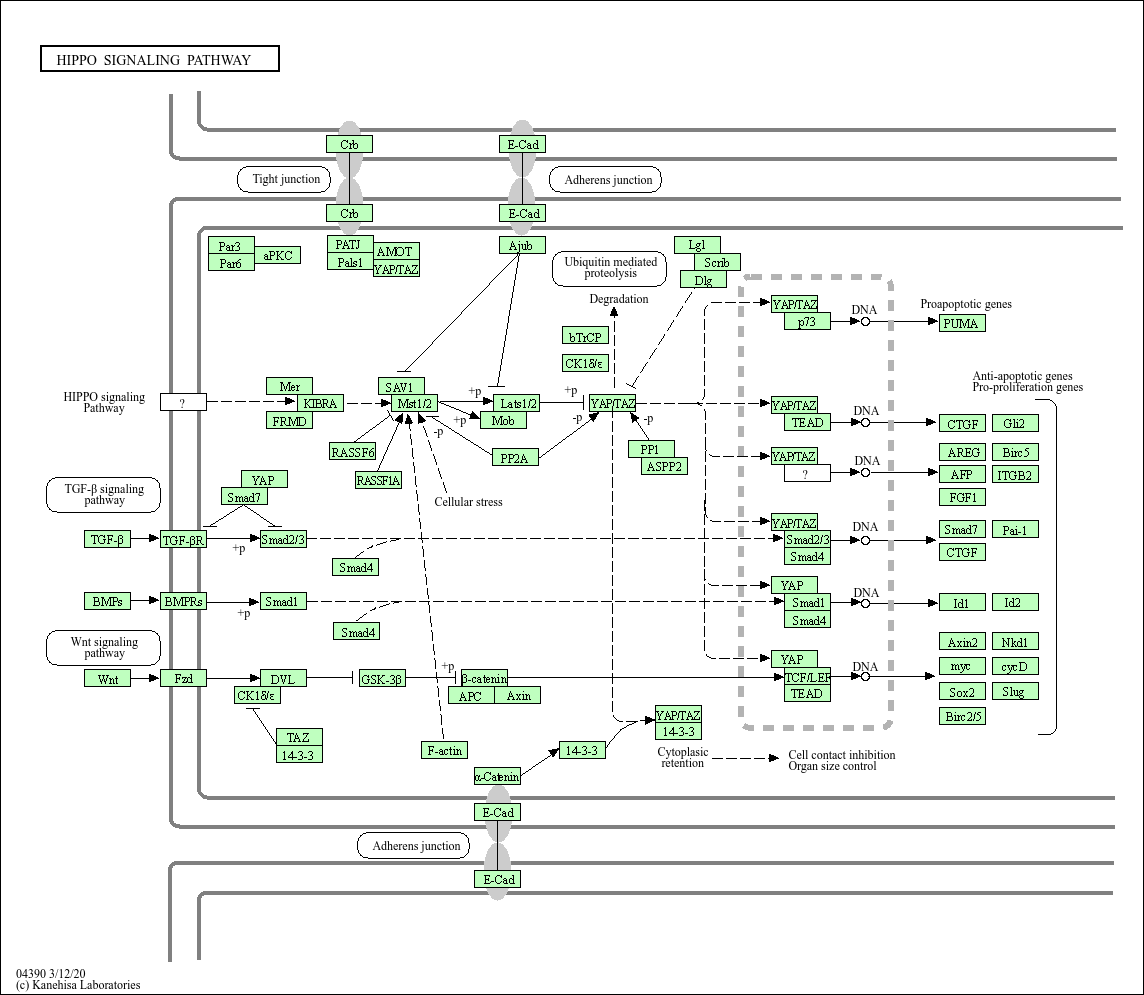
Its core function is to regulate cell proliferation, apoptosis, and organ size, maintaining tissue homeostasis. Its name is derived from the phenotype of excessive organ enlargement caused by mutations in Drosophila. The core of the pathway is a kinase cascade: MST1/2 forms a complex with SAV1, phosphorylating and activating LATS1/2 and MOB1, which in turn phosphorylate and inhibit the YAP/TAZ transcriptional co-activators. Phosphorylated YAP/TAZ are ubiquitinated and degraded, while unphosphorylated YAP/TAZ translocate to the nucleus and bind to TEAD family transcription factors, promoting the expression of proliferation-related genes such as Cyclin E and CTGF. Under normal conditions, the pathway maintains organ size by inhibiting excessive proliferation; pathway abnormalities (e.g., excessive activation of YAP/TAZ) can lead to malignant cell proliferation, which is closely associated with the occurrence and development of tumors such as liver cancer, lung cancer, and colorectal cancer, and is an emerging target for tumor therapy.
Core function: Regulate cell proliferation, apoptosis, and organ size to maintain tissue homeostasis; abnormal activation is associated with tumor progression. Key regulatory molecules: MST1/2, LATS1/2, YAP, TAZ, TEAD.
Core function: Regulate cell proliferation, apoptosis, and organ size to maintain tissue homeostasis; abnormal activation is associated with tumor progression. Key regulatory molecules: MST1/2, LATS1/2, YAP, TAZ, TEAD.
Product list
-
{{item.title}}{{item.react}}{{item.applicat}}
Product list
Product name
Reactivity
Application
Related Resource Links



Related Promotional Journal Downloads


Explore Our Recommended Popular Products
More products

30,000+ high- quality products available online
Primary Antibodies, Secondary Antibodies, mIHC Kits, ELISA Kits, Proteins, Molecular Biology Products,Cell Lines,Reagents ...
Contact Us
-

400-801-6722
-

support@lamarck.cn
-


Order
-

Message