


Th1 and Th2 cell differentiation
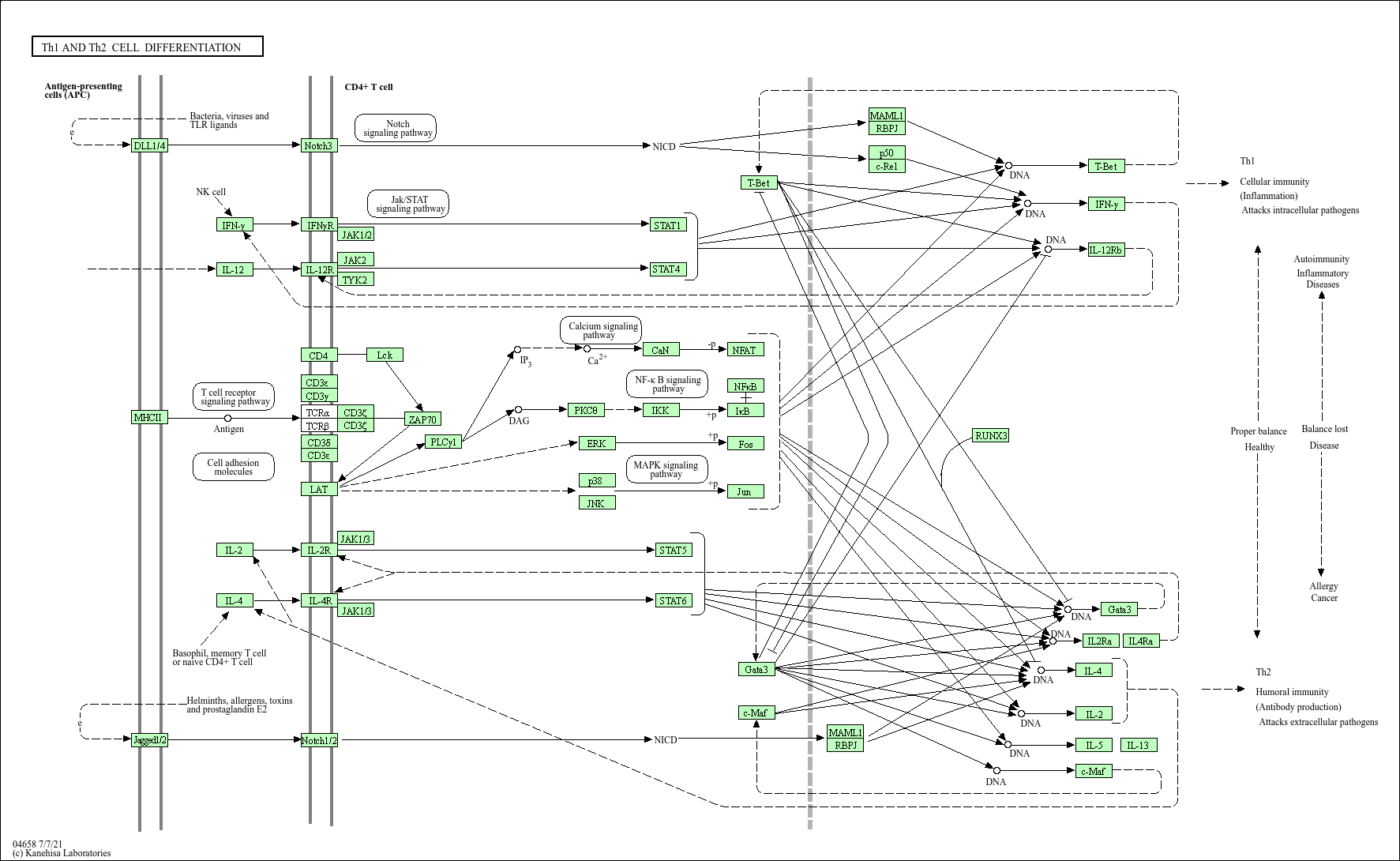
Core of basic research: Explores the molecular mechanism by which naive CD4+ T cells differentiate into functionally specialized Th1 or Th2 subsets under the regulation of cytokine microenvironments; their balance determines the type of immune response. Th1 differentiation depends on IL-12 (secreted by dendritic cells), which activates STAT4 upon receptor binding, inducing expression of the transcription factor T-bet. T-bet promotes IFN-γ secretion, forming a positive feedback loop; Th1 cells mainly mediate cellular immunity to clear intracellular pathogens. Th2 differentiation depends on IL-4 (secreted by mast cells and basophils), which activates STAT6, inducing expression of the transcription factor GATA3. GATA3 promotes secretion of IL-4/IL-5/IL-13, mediating humoral immunity and allergic reactions. Research focuses on the specificity of cytokine regulation on differentiation, mutual inhibition between transcription factors (T-bet vs. GATA3), stabilizing effects of epigenetic modifications (e.g., histone acetylation) on differentiation, and differentiation imbalance mechanisms in autoimmune diseases (e.g., Th1 dominance in rheumatoid arthritis) and allergic diseases (Th2 dominance).
Core key proteins: Naive CD4+ T cells, IL-12, STAT4, T-bet (core Th1 transcription factor), IFN-γ (signature Th1 cytokine), IL-4, STAT6, GATA3 (core Th2 transcription factor), IL-5/IL-13 (signature Th2 cytokines), IL-2 (promotes proliferation), SOCS1/SOCS3 (negative regulators).
Core key proteins: Naive CD4+ T cells, IL-12, STAT4, T-bet (core Th1 transcription factor), IFN-γ (signature Th1 cytokine), IL-4, STAT6, GATA3 (core Th2 transcription factor), IL-5/IL-13 (signature Th2 cytokines), IL-2 (promotes proliferation), SOCS1/SOCS3 (negative regulators).
Product list
-
{{item.title}}{{item.react}}{{item.applicat}}
Product list
Product name
Reactivity
Application
Related Resource Links



Related Promotional Journal Downloads


Explore Our Recommended Popular Products
More products

30,000+ high- quality products available online
Primary Antibodies, Secondary Antibodies, mIHC Kits, ELISA Kits, Proteins, Molecular Biology Products,Cell Lines,Reagents ...
Contact Us
-

400-801-6722
-

support@lamarck.cn
-


Order
-

Message