


Relaxin signaling pathway
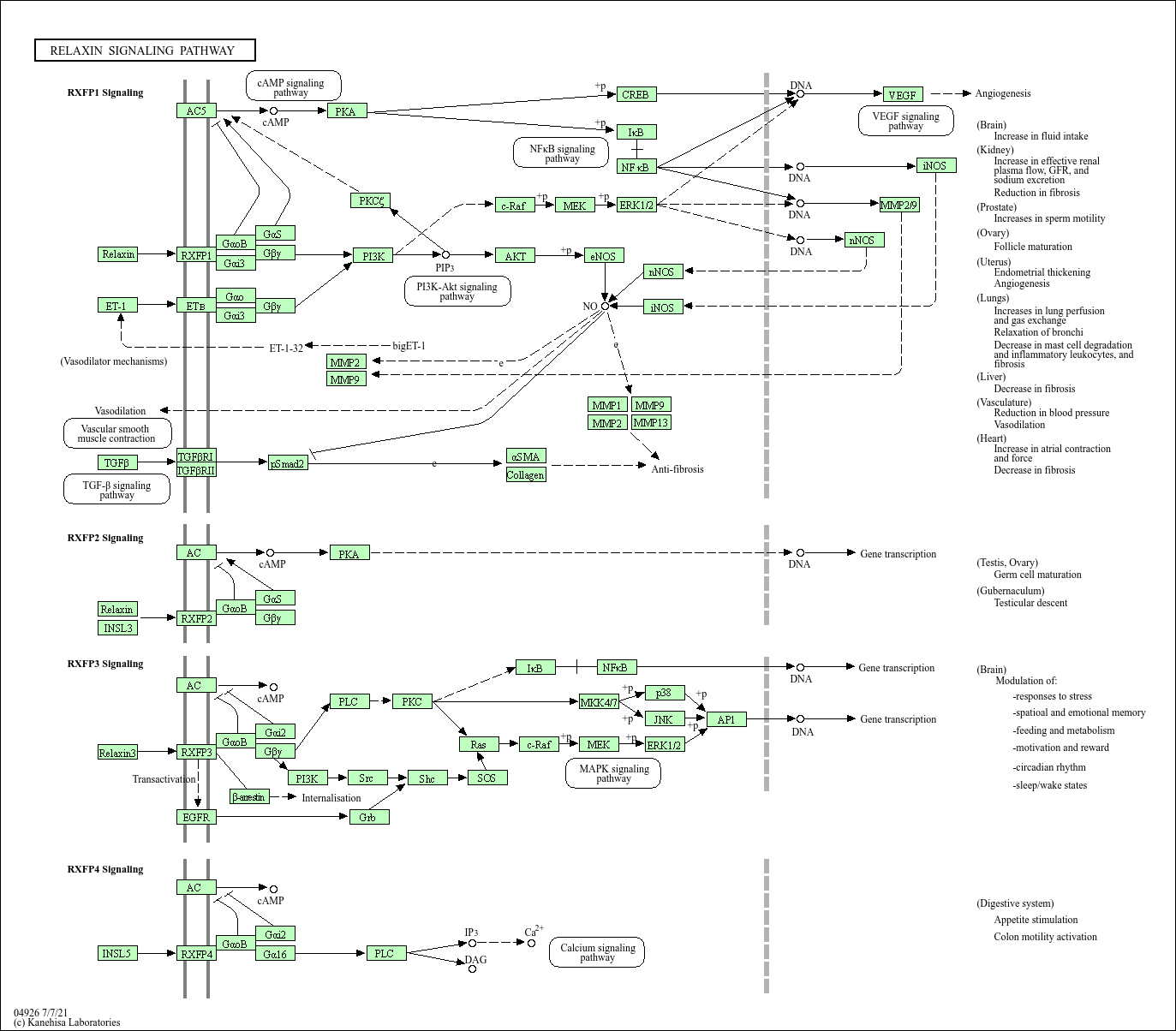
Core of basic research: Explores the molecular mechanism by which the relaxin (RLN) family regulates reproductive system remodeling, cardiovascular function, and connective tissue metabolism. The RLN family includes RLN1 (corpus luteum relaxin), RLN2 (placental relaxin), and RLN3 (brain relaxin), exerting effects mainly via binding to RXFP1/RXFP2 receptors. RLN2 binding to RXFP1 activates Gs proteins to promote cAMP production and the PI3K-Akt pathway, facilitating cervical collagen degradation and uterine smooth muscle relaxation before childbirth. In the cardiovascular system, RLN activates eNOS to generate NO, dilating blood vessels and lowering blood pressure. In connective tissue, RLN promotes matrix metalloproteinase (MMPs) expression to accelerate tissue remodeling. Research focuses on the tissue-specific expression of RLNs (ovary, placenta, brain), signal transduction specificity of RXFP receptors, MMP-mediated tissue remodeling mechanisms, and pathway associations with labor disorders (cervical ripening delay) and cardiovascular diseases (hypertension, heart failure).
Core key proteins: Relaxin (RLN1/2/3), RXFP1/RXFP2 (relaxin receptors), Gs protein, AC (adenylyl cyclase), cAMP, PKA (protein kinase A), PI3K/Akt (core signal pathway), MMP2/9 (matrix metalloproteinases, key tissue remodeling enzymes), eNOS (endothelial nitric oxide synthase), NO (nitric oxide, vasodilator), collagen (connective tissue component), cervical fibroblasts, vascular endothelial cells.
Core key proteins: Relaxin (RLN1/2/3), RXFP1/RXFP2 (relaxin receptors), Gs protein, AC (adenylyl cyclase), cAMP, PKA (protein kinase A), PI3K/Akt (core signal pathway), MMP2/9 (matrix metalloproteinases, key tissue remodeling enzymes), eNOS (endothelial nitric oxide synthase), NO (nitric oxide, vasodilator), collagen (connective tissue component), cervical fibroblasts, vascular endothelial cells.
Product list
-
{{item.title}}{{item.react}}{{item.applicat}}
Product list
Product name
Reactivity
Application
Related Resource Links


Related Promotional Journal Downloads


Explore Our Recommended Popular Products
More products

30,000+ high- quality products available online
Primary Antibodies, Secondary Antibodies, mIHC Kits, ELISA Kits, Proteins, Molecular Biology Products,Cell Lines,Reagents ...
Contact Us
-

400-801-6722
-

support@lamarck.cn
-


Order
-

Message